
Screen printing is widely used for mass production of electronic components, printed circuit boards, and various electrical materials.
SERIA provides high-quality plate-making for these industries and possesses the technical capabilities to meet the evolving demands for miniaturization and high precision.
Utilizing diverse plate-making technologies, we achieve precise pattern formation and high reproducibility.
Recently, our 'direct plate-making' has gained attention, contributing to both improved quality and production efficiency.
High-precision Plate-making
By combining high-density, high-strength metal mesh with our proprietary high-resolution photosensitive emulsion, We support various high-precision printing such as fine line, thin film, and thick film printing. We provide plate-making with excellent print reproducibility, dimensional accuracy, and durability required for electronic and electrical products, Strongly supporting the creation of high-quality products.
Ultra-fine Line Pattern
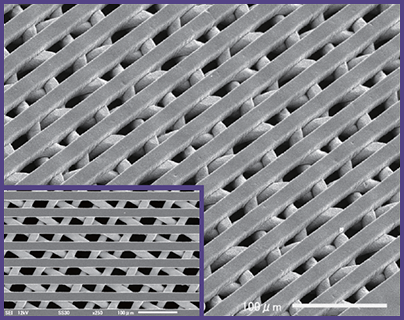
Inductor Pattern-Line Width 30μm
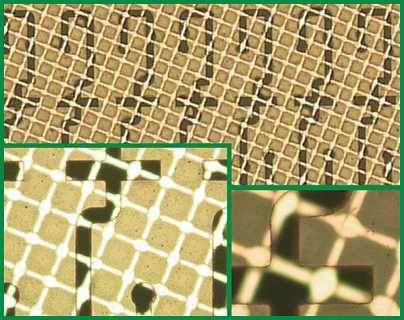
Combination Plate
The 'Combination Plate' is a hybrid plate-making method using SUS mesh for the pattern area and bonding different materials around it. Combinations such as SUS + polyester or SUS + SUS utilize the 'trampoline effect' in screen printing to achieve optimal printing performance. This method, offering excellent cost and print quality benefits, is now widely adopted as a standard specification.
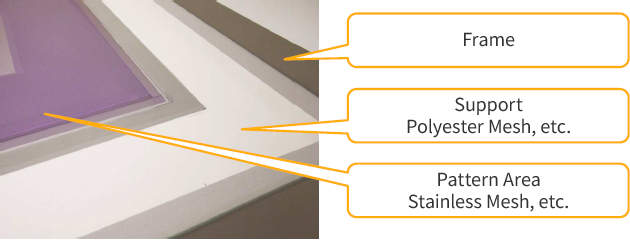
Flat Plate-making
A plate-making technology that dramatically improves print reproducibility.
Excessive adhesion between the screen plate and the substrate can cause sudden separation, leading to smudging.
SERIA's flat plate-making mixes flat and embossed areas on the same plate to effectively resolve separation issues without compromising printability.
Achieves high-precision and stable print quality.
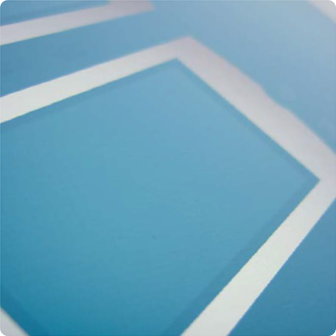
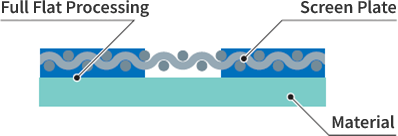
Without air escape paths, the material and plate adhere too tightly, causing poor separation.
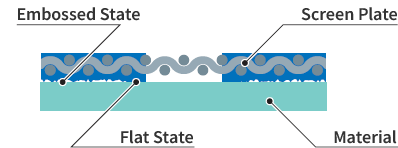
Embossed areas provide air escape paths to improve plate separation. Prevents ink scattering due to static electricity and excessive adhesion between material and plate.